
Right, so I’ve been on various forms of hormonal contraception since I was about seventeen, which means I’ve had a long time to notice things. Things like: why did I feel so flat in the gym for three months after switching pills? Why did the implant seem to make recovery harder, or was that just me getting older and blaming the wrong thing? Why is it so difficult to find straight answers that aren’t either wildly alarmist or basically “it’s fine, don’t worry about it”?
This post is my attempt to actually answer those questions — method by method, because that’s the bit that matters. Being on the combined pill is a completely different hormonal situation to having a Mirena, and the effect on your training reflects that. So rather than one big vague “hormones affect fitness” article, I’ve broken it down by contraceptive. Find your method, see what’s actually going on.
As always: I’m not a doctor, and this isn’t medical advice. There’s a note on that below.
A note before we start: I’m a blogger, not a doctor or a pharmacist. Everything here is based on research and my own experience, and it’s meant to help you ask better questions — not to replace the conversation with your GP or practice nurse. If you’re thinking about changing your contraception, or you’re experiencing something that’s affecting your daily life, please talk to someone qualified. They will not judge you for bringing up the gym.
- The Basics: How Hormonal Contraception Works
- What Happens to Your Natural Cycle
- How Birth Control Affects Your Workouts
- Specific Types and Their Effects
- Working With Your Contraception, Not Against It
- When to Consider Changing Contraception
- What About Coming Off Birth Control?
- The Bottom Line
- Ready to Learn More?
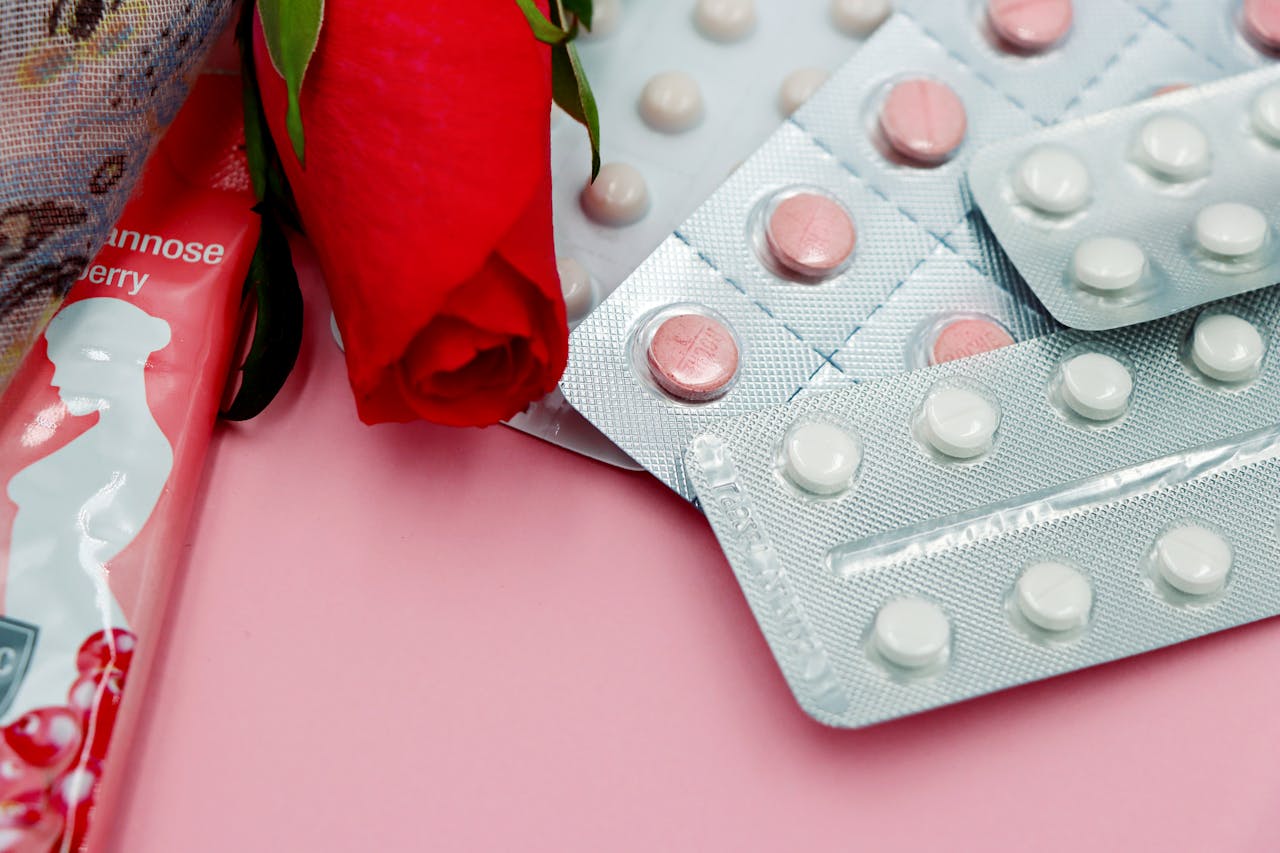
The Basics: How Hormonal Contraception Works
Most hormonal contraceptives work by releasing synthetic hormones – usually a combination of oestrogen and progestogen, or just progestogen alone. These hormones:
- Prevent ovulation (your ovaries don’t release an egg)
- Thicken cervical mucus
- Thin the womb lining
Different types of contraception deliver different hormones in different amounts:
Combined pill: Contains synthetic oestrogen and progestogen
Progestogen-only pill (mini pill): Contains only progestogen
Implant (Nexplanon): Progestogen only, releases hormones gradually
Hormonal IUD (Mirena, etc.): Progestogen only, mainly works locally
Injection (Depo-Provera): Progestogen only, lasts 12 weeks
Patch and ring: Combined hormones, similar to the pill
The copper coil (IUD) is non-hormonal, so it won’t affect your hormones or workouts in the same way.
What Happens to Your Natural Cycle
When you’re on hormonal contraception, you’re not having a natural menstrual cycle. The “period” you get on the pill is actually a withdrawal bleed from stopping the hormones for a week – it’s not a real period.
Without ovulation, you don’t get the natural rise and fall of oestrogen and progesterone that happens during a normal cycle. This means:
- No mid-cycle peak in energy and strength (from ovulation)
- No fluctuations in insulin sensitivity
- More stable (but artificial) hormone levels
- Different responses to exercise and nutrition
Some women prefer this stability. Others miss the natural energy boost that comes with ovulation. There’s no right or wrong – just different.
How Birth Control Affects Your Workouts
Muscle Building and Strength
This is probably the most researched area, and the findings are… mixed.
Combined pill: Some research suggests it might slightly reduce muscle protein synthesis (the process of building muscle). This doesn’t mean you can’t build muscle on the pill – you absolutely can – but it might be marginally slower than it would be naturally.
However, other studies show no significant difference in strength gains between women on the pill and those not on it. So it’s not a massive effect, if there is one at all.
Progestogen-only methods: Less research here, but they don’t seem to significantly impact muscle building either way.
The reality: If you’re training consistently, eating enough protein, and progressively overloading, you’ll build muscle whether you’re on contraception or not. Any effect is probably small enough that your training and nutrition matter far more.
Body Composition and Weight
Ah, the big question: does birth control make you gain weight?
The pill (combined): Research shows minimal to no weight gain directly from the pill. However, some women do experience increased appetite or water retention, which can lead to weight gain if you eat more.
Progestogen-only methods: The injection (Depo-Provera) is the most likely to cause weight gain, with studies showing an average gain of 2-3kg over a year. The implant and IUD have less consistent evidence for weight gain.
Water retention: Combined contraceptives can cause some water retention (1-2kg), which isn’t fat gain but can affect how you look and feel. This usually settles after a few months.
The reality: Birth control might affect your appetite, water retention, and where you store fat, but it won’t make you magically gain loads of weight. If you notice changes, it’s usually subtle and manageable.
Energy and Endurance
Natural hormone fluctuations give you different energy levels throughout your cycle. On hormonal contraception, you might notice:
More stable energy: No mid-cycle peak, but also no premenstrual crash. Some women prefer this consistency for training.
Slightly reduced VO2 max: Some research suggests the pill might minimally reduce cardiovascular capacity. We’re talking very small differences that most recreational athletes wouldn’t notice.
Less variation in performance: Without hormonal fluctuations, your performance might be more consistent week to week.
The reality: For most women, any effect on endurance is minimal. If you’re not an elite athlete, you probably won’t notice a difference.
Recovery
This is where things get interesting. Some research suggests that synthetic hormones might affect recovery from exercise:
Reduced inflammation response: Synthetic oestrogen might slightly blunt the inflammatory response to exercise, which could theoretically affect muscle adaptation. However, this hasn’t been shown to significantly impact actual fitness gains.
Sleep quality: Some women report better sleep on the pill (no PMS sleep disruption), whilst others report worse sleep. This would obviously affect recovery.
The reality: Recovery is more about sleep, nutrition, and training load than whether you’re on contraception.

Specific Types and Their Effects
The combined pill is the one most of us start on, usually as teenagers with absolutely no one explaining what oestrogen and progestogen actually do in the body. I was on it for years before I ever thought about how it might be affecting how I felt at the gym, or whether what I thought of as “just how I am” was partly just the specific pill I’d been put on at sixteen.
The short version: the combined pill tends to be the most “gym-friendly” of the hormonal options, relatively speaking, because the oestrogen component supports some of the things that help with training — but it’s not a straightforward positive story either.
The Combined Pill
Pros for fitness:
- Predictable “periods” (easier to plan training)
- No PMS symptoms to interfere with workouts
- Lighter, less painful periods
- Can skip periods if needed (for competitions, etc.)
Potential cons:
- Possible slight reduction in muscle building
- Some water retention initially
- Increased appetite for some women
- Potential impact on mood affecting motivation
Bottom line: Most women train just fine on the pill. Any negatives are usually manageable.
Progestogen-Only Pill (Mini Pill)
Pros for fitness:
- Fewer systemic side effects than combined pill
- Can be used by women who can’t take oestrogen
Potential cons:
- Irregular bleeding (annoying for training)
- Must be taken at the same time every day
- Some women report mood changes
Bottom line: Similar to combined pill, but bleeding patterns can be more unpredictable.
The Implant
I had the implant for a while and the main thing I noticed was a kind of low-level tiredness that I kept attributing to everything else — not sleeping well, work stress, doing too much. Whether that was the implant specifically or just life, I genuinely can’t tell you. That’s the frustrating thing about progesterone-only methods: the effects are real but they’re subtle enough to be deniable. You find yourself googling “implant making me tired” at 11pm and getting seventeen contradictory forum threads.
What I do know is that if you’re on the implant and your training feels off — heavier than it should, slower recovery, less motivation — it’s worth keeping a log for a few weeks rather than just assuming you’re not trying hard enough. You might not be imagining it.
Pros for fitness:
- Don’t have to think about it for 3 years
- Very effective
Potential cons:
- Unpredictable bleeding (can be frequent or absent)
- Some women report increased appetite
- Mood changes in some women
- Possible slight weight gain
Bottom line: The bleeding irregularity is the main workout inconvenience, but many women adapt.
Hormonal IUD (Mirena, etc.)
Pros for fitness:
- Mostly local hormone action (less systemic effect)
- Very light or absent periods over time
- Lasts 3-5 years
Potential cons:
- Irregular bleeding initially (settles over 3-6 months)
- Some women report mood changes despite low systemic hormones
Bottom line: Probably the least likely to significantly affect workouts due to low hormone levels.
The Injection (Depo-Provera)
Pros for fitness:
- No periods for many women
- Only need it every 12 weeks
Potential cons:
- Most likely to cause weight gain
- Can affect bone density (concern for very long-term use)
- Delayed return to fertility after stopping
Bottom line: The weight gain risk and bone density concerns make this less ideal for athletic women.
Working With Your Contraception, Not Against It
If you’re on hormonal contraception and want to optimise your training:
Focus on the Basics
Your training, nutrition, and recovery matter far more than any minor hormonal effects. Prioritise:
- Consistent strength training
- Adequate protein (1.6-2.2g per kg body weight)
- Enough calories (don’t under-eat)
- Quality sleep
- Progressive overload
Monitor Your Response
Track how you feel:
- Energy levels during workouts
- Recovery between sessions
- Mood and motivation
- Any changes in body composition
- Appetite changes
If you notice negative effects, give it 3-6 months for your body to adjust. If problems persist, speak to your GP about alternatives.
Adjust If Needed
If you’re experiencing:
- Increased appetite: Focus on protein and fibre to stay full
- Water retention: It usually settles, but reducing salt can help
- Reduced energy: Ensure you’re eating enough and sleeping well
- Irregular bleeding: Plan around it where possible, use period-proof underwear
- Mood issues: This is serious – speak to your doctor
Consider Your Goals
If you’re training for something specific:
- Building muscle: Ensure protein intake is adequate, focus on progressive overload
- Endurance events: Most women perform fine on contraception
- Fat loss: Focus on consistent calorie deficit and strength training
- General fitness: Contraception is unlikely to significantly impact this

When to Consider Changing Contraception
Your birth control might not be right for you if:
- Mood changes significantly affecting your quality of life
- You’ve gained significant weight despite no changes in diet/exercise
- Your energy is consistently terrible
- You’re experiencing other problematic side effects
- It’s significantly affecting your training and you’ve tried adjusting for 6+ months
There are many types of contraception available. If one doesn’t work, another might suit you better.
What About Coming Off Birth Control?
If you stop hormonal contraception:
Short term (first 3-6 months):
- Your natural cycle will return (can take a few months, especially after the injection)
- You might experience temporary hormonal fluctuations
- PMS might return if you had it before
- Periods might be heavier or more painful initially
For your workouts:
- You’ll start experiencing natural hormonal fluctuations again
- Energy might vary more throughout your cycle
- You might notice a mid-cycle strength peak (during ovulation)
- You’ll need to work around your actual period
Some women feel great coming off contraception. Others find the return of PMS and heavy periods challenging. Neither experience is universal.
The Bottom Line
Hormonal contraception does affect your body beyond just preventing pregnancy, but for most women, any impact on fitness and workouts is pretty minimal.
Yes, there might be slight effects on muscle building, endurance, or body composition, but these are generally small enough that your training, nutrition, and lifestyle factors matter far more.
If you’re training consistently and eating well, you can absolutely build muscle, lose fat, improve fitness, and hit your goals whilst on contraception.
The most important thing is finding a contraceptive method that works for your lifestyle, health, and preferences. If it’s not significantly affecting your quality of life or training, then it’s probably fine. If it is, there are other options available.
And remember: the best contraception is the one you actually use consistently. Don’t let minor potential effects on fitness stop you from preventing unwanted pregnancy.
As always, if you have concerns about your contraception, speak to your GP or a sexual health specialist. They can help you find what works best for you.
Now if you’ll excuse me, I’m off to lift some weights, regardless of what hormones are or aren’t floating around in my system.
If you’re on a method that isn’t in here, or you’ve noticed something specific that this post didn’t cover — I’d genuinely love to know in the comments. This is one of those topics where the collective anecdata from actual women is often more useful than the studies, because the studies tend to be underpowered and the women tend to have been paying very close attention.
Ready to Learn More?
Explore the complete guides:
Understanding Your Cycle:
- How to Exercise During Your Menstrual Cycle: A Week-by-Week Guide
- Can Exercise Really Help With PMS? Here’s What the Science Says
- Which Painkillers Work Best for Periods?
Managing Hormonal Conditions:
- PCOS and Exercise: What Actually Works (And What Doesn’t)
- Endometriosis and Fitness: How to Stay Active When Everything Hurts
Life Stage Changes:
- Perimenopause and Exercise: Why Your Usual Routine Might Not Be Working Anymore
- Menopause and Fitness: The Importance of Exercise for Women’s Health
Supporting Your Hormones: